State Senate — South Carolina
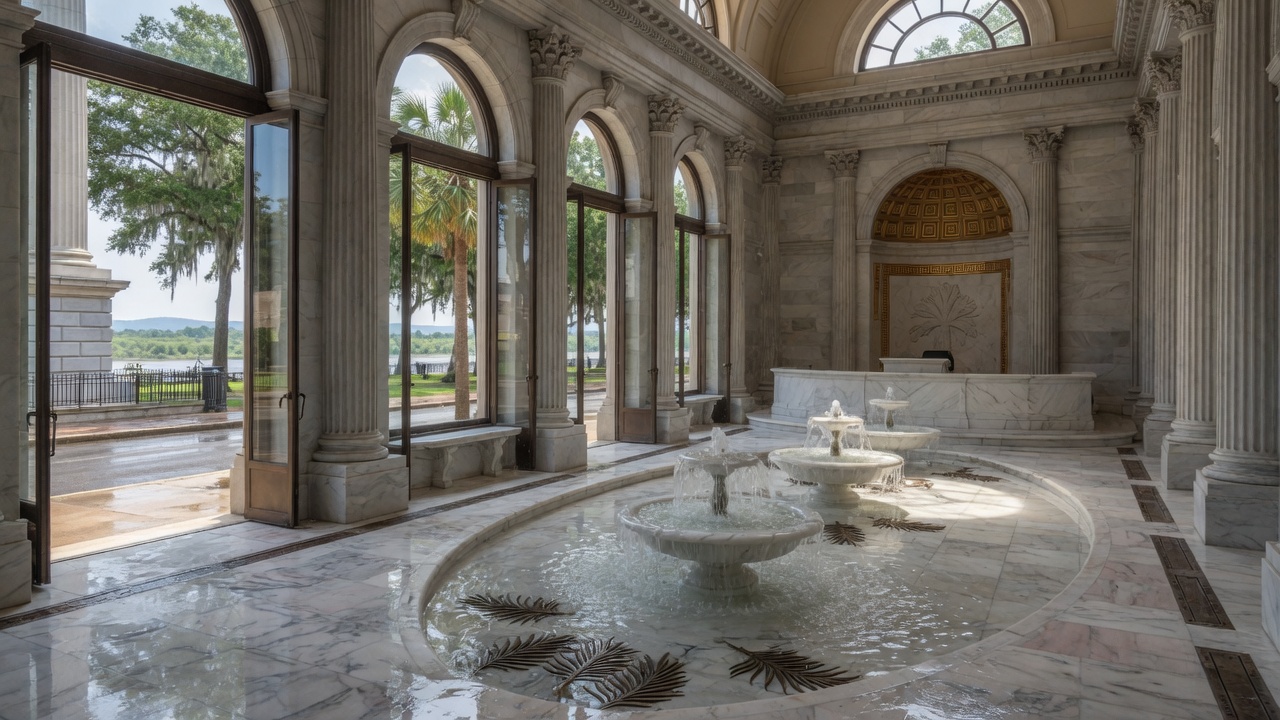
South Carolina State Senate · educational cover · Greek Senate · American Future Type
Forty-six desks, presidential years — regular class is 2028
The South Carolina State Senate is the upper house of the South Carolina General Assembly. Forty-six Senators. Article III of the South Carolina Constitution writes that chamber. The Senate is composed of members elected for four years from numbered single-member districts (Const. Art. III, § 6, as implemented by statute). The Assembly’s own door at scstatehouse.gov is the roster of record.
The term is four years. South Carolina does not stagger this chamber in the modern map. All forty-six seats stand together in presidential years. Last regular class: Tuesday, 5 November 2024. Next regular class: Tuesday, 7 November 2028.
2026 is not a regular South Carolina State Senate year. Do not invent a forty-six-desk race this November. Do not transplant Pennsylvania’s even-number stagger onto Columbia. The South Carolina House (one hundred twenty-four seats, two-year terms) does stand in 2026. The Governor does stand in 2026. Those are different desks. A Senate remainder can appear only if a vacancy actually posted. The State Election Commission posted a District 15 special for 3 November 2026. Confirm this district on scvotes.gov. A remainder is not the forty-six-desk class.
Senators take office on the Monday following the general election (Article III, Section 10). After a 2024 class that was Monday, 11 November 2024, with the regular session convening the second Tuesday of January in Columbia (Article III, Section 9). After a 2028 class that Monday is 13 November 2028. That is South Carolina’s clock. It is not Pennsylvania’s first of December. It is not Rhode Island’s first Tuesday of January.
This is not a United States Senate seat. The federal files live at South Carolina Class II and South Carolina Class III. Class II is 2026. This chamber does not vote in Congress, does not confirm federal judges, and does not sit in Washington.
This is not the South Carolina House of Representatives. One hundred twenty-four desks is a different house, on a two-year clock, and all 124 stand in 2026. This is not the Governor. This is not the Attorney General. This is not the Mayor of Columbia.
Columbia is the capital, in the midlands, on the Congaree, at the State House on Gervais Street. Charleston is the largest historic port. It is not the capital. The Upcountry, the Pee Dee, and the Lowcountry hire this chamber — forty-six districts, not one harbor.
South Carolina is forty-six counties. A State Senate district is not the whole state. Seat packets, when they ship, teach this district. This page teaches the chamber.
This page is Side One: inform, educate, inspire. It is not the race, not legal advice, and not an official government notice. For this cycle’s clock (no regular class), use the election twin.
Confirm the Senator of record on scstatehouse.gov — Senate.
The Senate elects its own President — Article III, Section 37
The Senate elects from among its members a President to preside, as soon as practicable after convening and every four years thereafter (Article III, Section 37, effective with the 2018 organization). That is South Carolina’s clock. The Lieutenant Governor does not gavel this floor. The Lieutenant Governor has been elected jointly with the Governor since 2018. People who transplant Georgia’s or Pennsylvania’s Lieutenant Governor chair onto Gervais Street are teaching a constitution that ended here in January 2019.
The President serves the quadrennium with the Senators. Majority and minority leaders are chosen by caucus. Standing committees — Finance; Judiciary; Education; Transportation; Medical Affairs; Fish, Game and Forestry — are how the work is actually cut. Confirm the current book on scstatehouse.gov. Do not treat a news comment as the committee list.
A Senator has two homes. The State House for the session. The district for the people who hired the seat. Staff who only know a Charleston harbor as the state, or only know a Myrtle Beach postcard as South Carolina, or only know a Greenville upcountry street as the whole map, are not doing the job. Gervais Street is the capitol. The Mayor of Columbia is a different office (Mayor of Columbia when that packet ships).
Monday after the election, not a staggered map
South Carolina writes state law in two houses. A bill that is not passed by this Senate is not South Carolina law. The Governor signs or vetoes; the General Assembly can override where the constitution actually gives it.
Advice and consent is state. Boards and appointments the constitution and statute actually name. Not a U.S. Senate hearing.
Vacancies: special elections under S.C. Code § 7-13-190. A primary on the eleventh Tuesday after the vacancy, a runoff on the thirteenth Tuesday if needed, the special on the twentieth Tuesday — or on the next general if that Tuesday falls inside sixty days of it. That is how a Senate line can appear in 2026 without a regular class. Confirm on the State Election Commission. Do not invent a Governor appointment as the default. Do not invent Pennsylvania’s writ.
There are no legislative term limits in South Carolina. Consecutive-term caps that apply to the Governor are not this desk.
Qualifications sit in Article III, Section 7: a Senator at least twenty-five, a duly qualified elector of the district. Always verify the current text. This page is teaching, not a filing packet.
Redistricting is legislature-dominant. Maps get litigated. Treat a statute and a court order as clocks. Confirm which map a given election actually used on the State Election Commission and the Revenue and Fiscal Affairs Office — not on a thread.
This is a citizen General Assembly: a modest salary plus per diem, a session that convenes the second Tuesday of January and customarily aims at sine die in May. Two homes still apply. Columbia for the sitting. The district for the hire.
scstatehouse.gov is the Columbia ledger
The official legislative door is scstatehouse.gov. Bills, committee notices, and the member of record belong there — not on a forwarded screenshot. Either house may, by majority, take a thirty-day recess. A missed sitting is still a real cost.
The official election door is the South Carolina State Election Commission. Registration, ballot status, and the sample ballot belong there and with the forty-six county boards of voter registration and elections.
Staff who only know a Facebook page are not doing the job. A constituent who was told “you can vote by text” was not told the truth until a .gov page says otherwise.
Columbia consent, not a Charleston file
A confirmation hearing is this chamber’s justice minute: an appointee the Governor named, a board that will actually touch a license, a prison, a school, or a river. It is not a trial. The Attorney General is the state’s lawyer (Attorney General of South Carolina — that desk is 2026). The Senate is not that office.
Equal protection on this map is not a Columbia-only file. An Upcountry precinct and a Lowcountry town hire the same Constitution. A district that never makes a State House broadcast still sits in this chamber. The U.S. Attorney and a Circuit judge are not this Senator.
The Catawba Indian Nation is a federally recognized nation on this map. It is not a county. This chamber writes state law that still has to live next to that fact. Do not invent a federal Indian-affairs desk.
After a hurricane year and a Congaree rise
Care this office actually gives is a bill and an oversight hour, not a church. Do not invent a ministry. A hurricane that makes landfall on the Lowcountry and then dumps rain on the midlands, a Congaree flood, an ice night in the Upcountry — those land as appropriations, emergency statutes, and questions to agencies the Governor runs.
Rural hospitals, a state prison, Medicaid as state policy, SCDOT, a National Guard year in state status: the Senate does not command the Guard (the Governor does). It writes and oversees the statutes those desks live under. Chaplaincy that exists in a prison or a Guard unit is that department’s staffing. It is not this page’s pulpit.
How a student learns Gervais Street
The General Assembly’s own shops — Legislative Council, bill drafting, the Legislative Audit Council, the Revenue and Fiscal Affairs Office — are how the work is actually learned. Page and intern openings belong on official legislative and university civic pages, not on a campaign site. A student who wants the civic path confirms those doors on .gov and campus postings. Clemson is a university town. It is not the capital. Charleston is not the capital. Columbia is.
County boards of voter registration and elections and the State Election Commission are how election work is learned. Richland County is not this chamber. A law-school clinic that files in Columbia still files in a court, not in a Senate committee.
Upcountry, midlands, and Lowcountry — not Charleston as the capital
Census and reapportionment. The state budget versus a supplemental. A presidential-year Senate clock. A hurricane track on the coast. A river stage on the Congaree, the Santee, the Savannah, or the Pee Dee. Committee attendance. Confirmation questionnaires. Dockets that a bill would actually change.
That is situational awareness for this chamber. It is not spy fiction. It is not a Mayor’s night radio. It is not the Attorney General’s case map.
Forty-six counties hire Columbia
The inbox is a state inbox split forty-six ways: a capital file from the State House that is not Charleston; a Charleston / Lowcountry harbor-and-hurricane file that is still not the capital; a Greenville / Upcountry file; a midlands file; a Pee Dee farm-and-port file; a Grand Strand file; and a Savannah River border file that is still South Carolina, not Georgia.
The Congaree at Columbia, the Saluda, the Broad, the Santee, the Savannah, the Pee Dee, and the Atlantic on the Lowcountry are this hydrology. A desert fountain is not this land. A Battery postcard is not the capital. Columbia is inland.
North Carolina is a different state. Georgia is a different state. Charleston looks east and remains South Carolina. It is not the capital.
Staff who only know the State House, or only know Charleston as South Carolina, are on the wrong office.
Midlands clock
- State: South Carolina · Office: State Senate · 46 seats
- Term: four years · not staggered · all forty-six in presidential years
- Last regular class: 5 November 2024
- Next regular class: 7 November 2028 — not a 2026 whole-chamber race
- 2026: no regular Senate class; confirm any remainder (including District 15) on the State Election Commission
- Take office: Monday following the election
- Convene: second Tuesday of January, Columbia
- Chair: Senate elects its own President (Art. III, § 37) — Lieutenant Governor does not preside
- Capital: Columbia (State House, midlands, Congaree) — not Charleston
- Counties: 46
- Land the chamber serves: the whole state, in forty-six districts — Upcountry, midlands, Pee Dee, Lowcountry, Grand Strand
- Always verify the Senator of record on scstatehouse.gov
Orientation adapted from the South Carolina Constitution, the General Assembly, and South Carolina official election sources for education. The Senator of record is whatever the official site says today.
Not Charleston. Not 2026 as 2028.
- Not a United States Senator (Class II is 2026; Class III is 2028).
- Not a U.S. Representative (seven House districts; two-year terms).
- Not the South Carolina House of Representatives (124 seats — a different chamber; all 124 on 2026).
- Not the Governor of South Carolina (2026). Not the Lieutenant Governor (who does not preside here).
- Not the Attorney General of South Carolina (2026).
- Not the Mayor of Columbia or Charleston.
- Not North Carolina. Not Georgia. Not Charleston, West Virginia.
- Not Charleston as the capital. Not the Battery as the whole map.
- Not a 2026 regular Senate class. Next regular is 2028.
- Not a staggered Senate. All forty-six last stood in 2024.
- Not a campaign flyer. This page does not tell anyone who to vote for.
Doors on Gervais
- South Carolina General Assembly
- South Carolina Senate
- South Carolina State Election Commission
- Office of the Governor (not this chamber)
The arena: 2026 clock — South Carolina State Senate (regular class is 2028)