Michigan House of Representatives
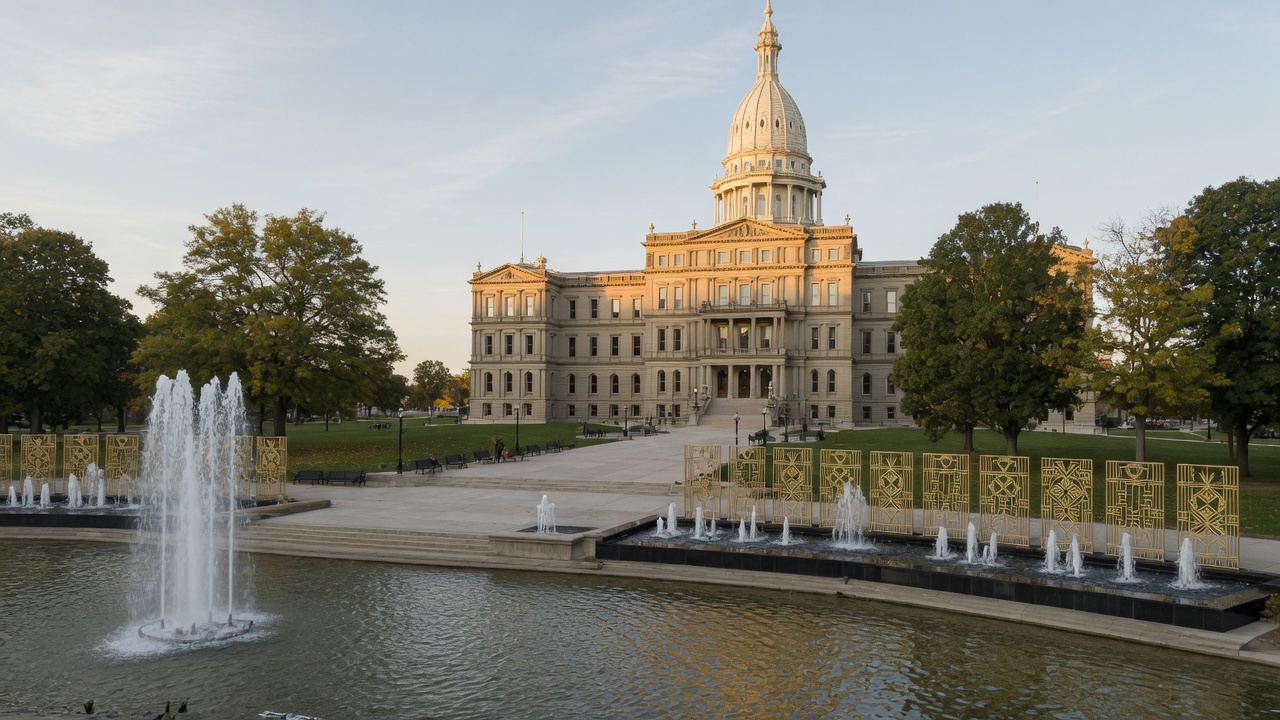
Michigan House of Representatives · educational cover · Greek Orthodoxy civic grammar · American Future Type
One hundred ten two-year desks on the Grand River
The Michigan House of Representatives is the lower house of the Michigan Legislature. One hundred ten Representatives. Article IV, Section 3 of the Michigan Constitution of 1963 writes that chamber: one hundred ten members elected for two-year terms from single-member districts. Confirm the live count and the member of record on legislature.mi.gov.
The term is two years. Michigan does not stagger this chamber. All one hundred ten seats stand every even year. That is the opposite of the Senate’s four-year class: thirty-eight desks, not staggered, all on the same Tuesday as the Governor. The next regular House election is Tuesday, November 3, 2026. Representatives take office at noon on January 1 next following the election (MCL 168.173; Article XI, Section 2). After this class that is noon, Thursday, 1 January 2027. The body convenes each year on the second Wednesday of January at noon (Article IV, Section 13). That is Michigan’s clock. It is not Indiana’s day-after. It is not Alabama’s midnight of election day.
This is not a United States House seat. Michigan sends thirteen Representatives to Congress on a two-year clock. Those files live under U.S. House. This chamber does not vote in Congress, does not sit in Washington, and does not split a federal district.
This is not the Michigan State Senate. Thirty-eight desks is a different house — four-year, not staggered, Lieutenant Governor as President, all thirty-eight this Tuesday. This is not the Governor — Michigan’s Governor is also on 2026, a different desk. This is not the Attorney General — that desk is 2026 as well. This is not the Mayor of Lansing.
Lansing is the capital, in Ingham County, on the Grand River and the Red Cedar, at the State Capitol. It is not a Great Lakes port. Detroit is the largest city. It is not the capital. The Upper Peninsula is Michigan. A map that stops at the Mackinac Strait is a wrong map. Farm counties, the Soo, a Thumb precinct, Grand Rapids, Flint, Ann Arbor, and a Detroit neighborhood hire this chamber — one hundred ten districts, not one skyline.
Michigan is eighty-three counties. A State House district is not the whole state. Seat packets, when they ship, teach this district. This page teaches the chamber.
The House elects its own Speaker. The Lieutenant Governor is President of the Senate. That gavel is not this floor. Confirm officers on legislature.mi.gov.
A Representative has two homes. The Capitol for the session. The district for the people who hired the seat. Staff who only know downtown Detroit, or only know a Grand Rapids skyline as the state, or only know a campus town as Michigan, are not doing the job. The Capitol is the capitol. The Mayor of Lansing is a different office (Mayor of Lansing). East Lansing is a different city.
This page is Side One: inform, educate, inspire. It is not the race, not legal advice, and not an official government notice. For this cycle, use the election twin.
Confirm the Representative of record on legislature.mi.gov.
Bills may start in either house; January 1 is the oath
Michigan writes state law in two houses. A bill that is not passed by this House is not Michigan law. The Governor signs or vetoes; the Legislature can override where the constitution actually gives it. Item veto on appropriations is a Governor tool.
Article IV, Section 22 is this chamber’s hinge, and it is not an origination clause: all legislation shall be by bill and may originate in either house. Do not transplant a money-bills-start-here rule onto Michigan. The House still keeps the money work in Appropriations and tax policy. A school-aid year and a roads-and-prisons year are not the same bill. Confirm the current text. This page is teaching, not a drafting manual.
Article IV, Section 26 is the five-day rule: no bill becomes law at a regular session until it has been printed and in the possession of each house for at least five days. Article IV, Section 27 holds a ninety-day wait after session unless two-thirds give immediate effect. Those are Michigan clocks. They are not Alabama. They are not Minnesota’s origination rule.
Qualifications sit in Article IV, Section 7: a Representative must be a citizen of the United States, at least twenty-one, and an elector of the district. Removal of domicile from the district vacates the office. Always verify the current text.
Legislative term limits are a clock, not a crown. Article IV, Section 54, as the people amended it in 2022, caps combined service in the House and Senate at twelve years. That is not the old three-House-plus-two-Senate split. A mailer that still teaches six House terms as a separate bucket is teaching a retired clock.
The House elects its Speaker and other officers. Standing committees — Appropriations; Tax Policy; Judiciary; Education; Natural Resources and Outdoor Recreation; Health Policy; Transportation, Mobility and Infrastructure — are how the work is actually cut. Confirm the current book on legislature.mi.gov. Do not treat a screenshot as the committee list.
legislature.mi.gov and the Michigan Voter Information Center
The official legislative door is legislature.mi.gov and the House’s own shop at house.mi.gov. Bills, fiscal notes, committee notices, today’s calendar, and the member of record belong there — not on a forwarded screenshot. Michigan is a year-round Legislature by national measure. Confirm today’s sitting on that site. Do not invent a sine-die that the calendar does not show.
The official election door is the Michigan Secretary of State — Elections and the Michigan Voter Information Center. Registration, ballot status, and the sample ballot belong there and with the eighty-three county clerks.
Maps for this chamber are drawn by the Independent Citizens Redistricting Commission (Article IV, Section 6) — not a legislative self-draw. Treat a commission plan and a court order as clocks. Confirm which map a given election actually used on the Secretary of State — not on a thread.
A constituent who was told “you can vote by a text thread” was not told the truth until a .gov page says otherwise.
Articles from this floor; a Governor's special fills a hole
Michigan’s House has the sole power of impeaching civil officers (Article XI, Section 7). A majority of members elected and serving directs the impeachment. The House elects three of its members to prosecute. The Senate tries, after final adjournment. Conviction is not a district-court docket and not the Attorney General’s case map (Attorney General of Michigan — that desk is 2026). Do not teach a federal impeachment as this file.
Vacancies in this House are not a caucus gift. MCL 168.634: the Governor may call a special election in the district or direct that the vacancy be filled at the next general election. If the hole opens after the statewide primary and before the general, party executive committees may certify a nominee. Confirm on the Secretary of State. Do not invent an appointment of the Representative.
Equal protection on this map is not a Detroit-only file. A Keweenaw precinct and a Wayne County neighborhood hire the same Constitution. A district that never makes a Grand River broadcast still sits in this chamber. The U.S. Attorney and a circuit judge are not this Representative.
Twelve federally recognized nations sit on this map. They are not counties. This chamber writes state law that still has to live next to that fact. Do not invent a federal Indian-affairs desk.
Each house judges its own members. Expulsion is this constitution’s file, not a comment section.
A lake-effect statute is not a parish
Care this office actually gives is a bill and an appropriation, not a church. Do not invent a ministry. A lake-effect night on the Thumb, a Grand River flood at Lansing, a freeze on fruit in the west, a UP winter that never makes a Detroit press conference — those land as House Appropriations hours, emergency statutes, and questions to agencies the Governor runs.
Rural hospitals, a state prison, Medicaid as state policy, MDOT, a National Guard year in state status: the House does not command the Guard (the Governor does). It writes and oversees the statutes those desks live under. Chaplaincy that exists in a prison or a Guard unit is that department’s staffing. It is not this page’s pulpit. The gold geometry on this cover is civic grammar. It is not a parish substituting for the Legislature.
How a student learns the Lansing house
The Legislature’s own shops — the House Fiscal Agency, the Legislative Service Bureau, the Clerk of the House — are how the work is actually learned. Page and intern openings belong on official legislative and university civic pages, not on a campaign site. A student who wants the civic path confirms those doors on .gov and campus postings. Ann Arbor is a university city. It is not the capital.
Appropriations is how a student learns a year that may start in either house. County clerks and the Secretary of State’s Elections Division are how election work is learned. Ingham County is not this chamber. A law-school clinic that files in Lansing still files in a court, not in a House committee.
Two peninsulas, an Independent Commission, a noon oath
Census and the Independent Citizens Redistricting Commission. The general appropriation bills under Article IV, Section 31. A five-day print rule. A noon January 1 oath. A lake-effect warning. A river stage at Lansing. A drought report from a farm county that never makes a Detroit broadcast. Committee attendance. A year-round calendar that is not a sine-die transplant.
That is situational awareness for this chamber. It is not spy fiction. It is not a Mayor’s night radio. It is not the Attorney General’s case map. It is not a U.S. House whip count.
Eighty-three counties still split this inbox
The inbox is a state inbox split one hundred ten ways: a capital file from the Grand River that is not Detroit; a Wayne city file that is the largest metro and still not the capital; a Grand Rapids / Kent file; a Flint file; an Ann Arbor campus file; a Thumb farm-and-lake file; a west-Michigan fruit file; and an Upper Peninsula woods-and-ore file from a county that never makes a Lansing broadcast.
The Grand River, the Red Cedar, the Detroit River, the St. Marys at the Soo, and the four Great Lakes that actually touch this state are this hydrology. A civic fountain on the capitol grounds is civic water. An invented Detroit harbor as the capital is not this map. Detroit is not Lansing. Lansing is not a Great Lakes port.
Ohio is a different state. Indiana is a different state. Wisconsin is a different state. Ontario is a different country. The Straits of Mackinac are water, not a county. Staff who only know the Capitol, or only know Detroit as Michigan, are on the wrong office.
Grand River clock
- State: Michigan · Office: House of Representatives · 110 seats
- Term: two years · not staggered · all one hundred ten the same even year
- Next regular class: 3 November 2026
- Take office: noon, 1 January 2027
- Money bills: may originate in either house (Article IV § 22) — no origination clause
- Speaker: elected by the House — Lieutenant Governor does not preside
- Term limit: 12 combined years in the Legislature (Art. IV § 54, 2022)
- Maps: Independent Citizens Redistricting Commission
- Capital: Lansing (State Capitol, Ingham County, Grand River) — not Detroit, not a Great Lakes port
- Counties: 83
- Land the chamber serves: the whole state, in one hundred ten districts — both peninsulas, lakes, farm counties, Detroit metro, Grand Rapids, UP
- Always verify the Representative of record on legislature.mi.gov
Orientation adapted from the Michigan Constitution, the Legislature, and Michigan official election sources for education. The Representative of record is whatever the official site says today.
Not Detroit's chamber
- Not a United States Representative (thirteen congressional districts; two-year terms — U.S. House).
- Not a United States Senator (Class II is 2026; Class I is 2030).
- Not the Michigan State Senate (38 seats, four-year, not staggered — Michigan State Senate).
- Not the Governor of Michigan (2026). Not the Lieutenant Governor (who presides in the Senate, not here).
- Not the Attorney General of Michigan (2026).
- Not the Mayor of Lansing, Detroit, Grand Rapids, or Flint.
- Not Ohio. Not Indiana. Not Wisconsin. Not Ontario.
- Not Detroit as the capital. Not a Great Lakes port as the capital. Not a map that drops the Upper Peninsula.
- Not Nebraska. Nebraska has no lower house.
- Not a campaign flyer. This page does not tell anyone who to vote for.
Capitol doors
- Michigan Legislature
- Michigan House of Representatives
- Michigan Secretary of State — Elections
- Michigan Voter Information Center
- Office of the Governor (writs for vacancies — not this chamber)
The arena: 2026 election — Michigan House of Representatives
All State Houses · State Senate · Governor · U.S. House · Legal