State Senate — Vermont
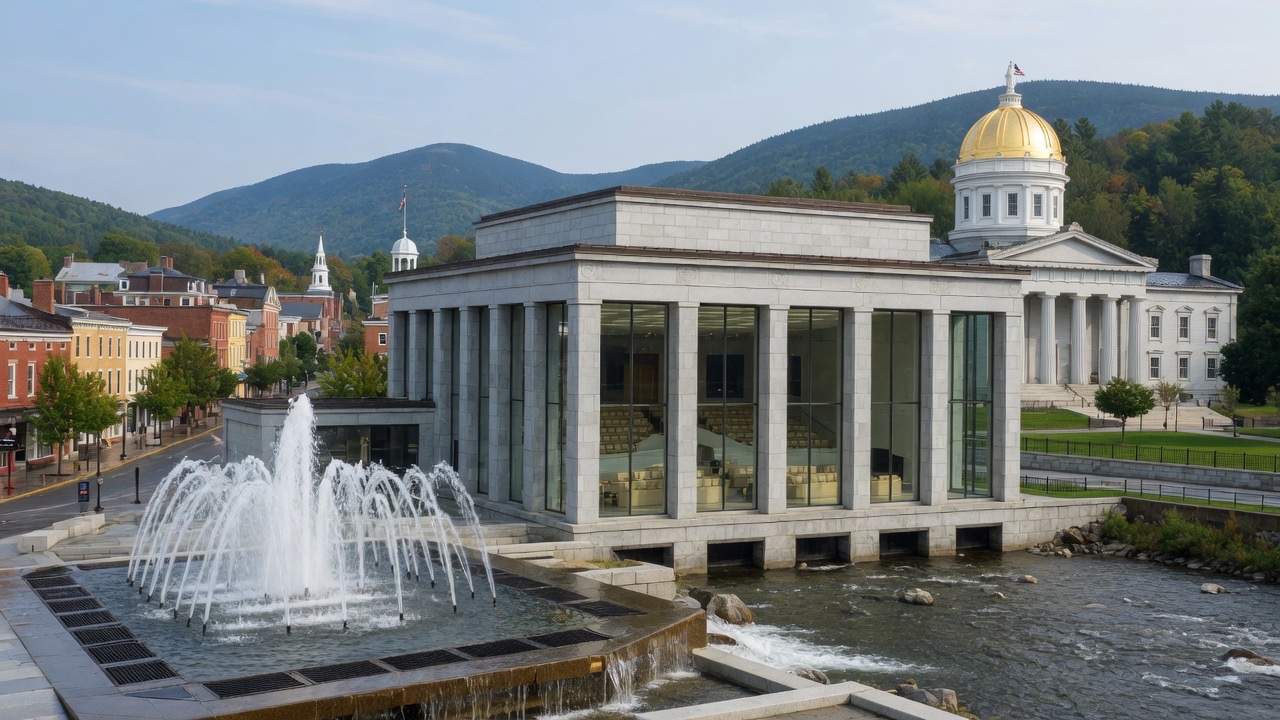
Vermont State Senate · educational cover · Greek Senate · American Future Type
Montpelier is the capital on the Winooski — not Burlington
The Vermont State Senate is the upper house of the Vermont General Assembly. Thirty Senators. Chapter II, Section 18 of the Vermont Constitution writes that chamber: thirty Senators, elected from senatorial districts established by law, one or more from each district. The term is two years, commencing on the first Wednesday next after the first Monday of January following the election (Chapter II, Section 46). The Assembly’s own door at legislature.vermont.gov is the roster of record.
Montpelier is the capital, in Washington County, on the Winooski, at the golden-dome State House on State Street. It is not Burlington. Burlington is the largest city, on Lake Champlain in Chittenden County. It is not the capital. The Northeast Kingdom, the Green Mountains, the Connecticut River towns, and the Lake towns hire this chamber — sixteen districts, not one waterfront.
This is not a United States Senate seat. The federal files live at Vermont Class I and Vermont Class III. Vermont has no Class II. There is no 2026 U.S. Senate race. Class I is 2030. Class III is 2028. This chamber does not vote in Congress, does not confirm federal judges, and does not sit in Washington.
This is not the Vermont House of Representatives. One hundred fifty desks is a different house, also on a two-year clock, and all one hundred fifty stand in 2026. This is not the Governor — Vermont’s Governor is also two-year and is on 2026, a different desk. This is not the Attorney General — that desk is also two-year and is on 2026. This is not the Mayor of Montpelier.
Vermont is fourteen counties and two hundred fifty-one towns, cities, and gores. Town Meeting is a local clock. This Senate is a November even-year clock. A State Senate district is not the whole state. Seat packets, when they ship, teach this district. This page teaches the chamber.
This page is Side One: inform, educate, inspire. It is not the race, not legal advice, and not an official government notice. For this cycle, use the election twin.
Confirm the Senator of record on legislature.vermont.gov.
Thirty desks, sixteen districts, all up every two years
The term is two years. This chamber is not staggered. All thirty seats stand Tuesday, 3 November 2026. Vermont and New Hampshire are the two states that still run two-year terms in both houses. Do not transplant Tennessee’s four-year stagger or Texas’s lot-draw onto Vermont.
The thirty Senators are elected from sixteen senatorial districts. Seven districts elect one Senator. Four elect two. Five elect three. Districts that elect more than one Senator use plurality block voting: a voter may mark as many names as there are seats. Electoral fusion is still Vermont law: a candidate may carry more than one party nomination on the same ballot line. Confirm the current district act and the current ballot form on the Secretary of State. Do not invent a single-member map as the default.
The primary for this class already ran 11 August 2026. Filing closed 28 May 2026. Names that belong on a sample ballot live on sos.vermont.gov/elections — not on this page.
The Lieutenant Governor is President — the people hire that chair
Vermont does elect a Lieutenant Governor statewide, on a two-year clock, on 2026. Chapter II, Section 19 makes that officer President of the Senate, with a casting vote and no other. When the Lieutenant Governor is exercising the office of Governor, or the office is vacant, or the Lieutenant Governor is absent, the Senate appoints one of its own members President pro tempore. The people hire the President. The Senate hires the pro tem. That is Vermont’s clock. Utah’s Senate-elected President is a different machine. Do not invent a Senate election for the statewide gavel.
Standing committees — Finance; Appropriations; Judiciary; Education; Health and Welfare; Natural Resources and Energy; Transportation — are how the work is actually cut. Confirm the current book on legislature.vermont.gov. Do not treat a news comment as the committee list.
A Senator has two homes. State Street for the session. The district for the people who hired the seat. Staff who only know Church Street in Burlington, or only know a ski town as the state, or only know a Kingdom village as Vermont, are not doing the job. The Mayor of Montpelier is a different office (Mayor of Montpelier).
First Wednesday after the first Monday in January
Senators take office the first Wednesday next after the first Monday of January following the election. After this class that is Wednesday, 6 January 2027. The General Assembly meets biennially on that same Wednesday, beginning 1915 (Chapter II, Section 7). The second year of the biennium is set by joint resolution and usually returns in January of the even year. There is no constitutional day-count cap on a Vermont session. Adjournment is a political clock, usually late spring. Confirm on legislature.vermont.gov.
Vermont writes state law in two houses. A bill that is not passed by this Senate is not Vermont law. The Governor signs or vetoes; the Legislature can override where the constitution actually gives it. A two-thirds override is a real number in a 30-seat chamber.
Advice and consent is state, and it is thinner than a Texas two-thirds confirmation calendar. Appointments statute actually names still sit in committee. They are state. Not a U.S. Senate hearing.
Vacancies sit in Chapter II, Section 45 (manner established by law) and statute: the Governor selects a replacement to fill a vacant General Assembly seat. Confirm the current text of Title 17 on legislature.vermont.gov. That is not a special election as the default. Do not transplant Texas’s writ onto Vermont.
Vermont has no legislative term limits. Qualifications: a resident of the state two years, and of the district one year, immediately preceding the election. Always verify the current text of Chapter II, Section 18.
Redistricting is legislative. The 2022 act set the sixteen Senate districts. Treat a statute map and a court order as clocks. Confirm which map a given election actually used on the Secretary of State — not on a thread.
legislature.vermont.gov is the State House book
The official legislative door is legislature.vermont.gov. Bills, committee notices, the calendar, and the member of record belong there — not on a forwarded screenshot. A session without a day-count cap is still a real clock. A missed week is a real cost.
The official election door is the Vermont Secretary of State — Elections and MVP.vermont.gov. Registration, town clerks, and the official sample ballot belong there and with the town clerks — Vermont’s election work still runs through the town, not only through fourteen county desks.
Staff who only know a Facebook page are not doing the job. A constituent who was told “you can vote by text” was not told the truth until a .gov page says otherwise.
A Governor names a hole until the next clock
A confirmation minute, when statute actually gives one, is this chamber’s justice hour: an appointee a board that will actually touch a license, a river, a school, or a mountain. It is not a trial. The Attorney General is the state’s lawyer (Attorney General of Vermont), two-year, on 2026. The Senate is not that office.
Equal protection on this map is not a Chittenden-only file. An Essex County precinct and a Montpelier neighborhood hire the same Constitution. A district that never makes a Burlington broadcast still sits in this chamber. The U.S. Attorney and a superior judge are not this Senator.
Abenaki people sit on this land. Federal recognition is a different clock than a state acknowledgment. They are not counties. This chamber writes state law that still has to live next to that fact. Do not invent a federal Indian-affairs desk.
After a Winooski flood and a thaw on the Lake
Care this office actually gives is a bill and an oversight hour, not a church. Do not invent a ministry. A Winooski flood year in Montpelier, a thaw and freeze on Lake Champlain, a drought on a Kingdom farm, a mud-season road year that is state statute sitting next to town highway law — those land as appropriations, emergency statutes, and questions to agencies the Governor runs.
Rural hospitals, a state prison, Medicaid as state policy, VTrans, a National Guard year in state status: the Senate does not command the Guard (the Governor does). It writes and oversees the statutes those desks live under. Chaplaincy that exists in a prison or a Guard unit is that department’s staffing. It is not this page’s pulpit.
How a student learns State Street
The General Assembly’s own shops — the Office of Legislative Counsel, the Joint Fiscal Office, the Sergeant at Arms — are how the work is actually learned. Page and intern openings belong on official legislative and university civic pages, not on a campaign site. The University of Vermont is in Burlington. Vermont Law and Graduate School is in South Royalton. Neither is the capital. Montpelier is the capital.
Town clerks and the Secretary of State’s Elections Division are how election work is learned. Washington County is not this chamber. A law-school clinic that files in Montpelier still files in a court, not in a Senate committee.
Kingdom, Greens, and the Lake — not Burlington as the capital
Census and legislative maps. The state budget versus a supplemental. A biennium that starts in January of the odd year. A flood warning on the Winooski. A freeze report from a Lake town. A mud-season report from a Kingdom town clerk. Committee attendance. Dockets that a bill would actually change.
That is situational awareness for this chamber. It is not spy fiction. It is not a Mayor’s night radio. It is not the Attorney General’s case map.
Fourteen counties and two hundred fifty-one towns hire Montpelier
The inbox is a state inbox split sixteen ways: a capital file from Montpelier that is not Burlington; a Chittenden / Burlington / Lake file that is the largest population and still not the capital; a Washington / Barre file; a Northeast Kingdom file from Newport, St. Johnsbury, and the high towns; a Connecticut River file from Windsor and Windham; a Bennington / Rutland southwest file; an Addison / Middlebury farm-and-campus file; and a Franklin / St. Albans north-lake file that never makes a Church Street broadcast.
The Winooski, the Connecticut, the Otter Creek, the Lamoille, and Lake Champlain are this hydrology. A lake-port postcard is not the capital. A Burlington postcard is not the whole state. Montpelier sits on the Winooski. The Kingdom is still this chamber.
New Hampshire is a different state. Massachusetts is a different state. New York is a different state. Quebec is a different sovereign. White River Junction looks at New Hampshire and remains Vermont. Derby Line looks at Canada and remains Vermont.
Staff who only know the State House, or only know Burlington as Vermont, are on the wrong office.
Place snapshot (verify official sources)
- State: Vermont · Office: State Senate · 30 seats from 16 districts
- Term: two years · not staggered · all 30 this biennium
- Next regular class: 3 November 2026 (all seats)
- Take office: first Wednesday after the first Monday in January — 6 January 2027
- Term limits: none
- President of the Senate: the Lieutenant Governor (statewide, two-year, 2026) — casting vote only
- Governor: two-year · on 2026 (a different desk)
- U.S. Senate 2026: none (no Class II)
- Capital: Montpelier (State House, Washington County, Winooski) — not Burlington
- Counties: 14 · towns / cities / gores: 251
- Land the chamber serves: the whole state, in sixteen districts — Kingdom, Greens, Lake, Connecticut River, capital
- Always verify the Senator of record on legislature.vermont.gov
Orientation adapted from the Vermont Constitution, the General Assembly, and Vermont official election sources for education. The Senator of record is whatever the official site says today.
What this is not
- Not a United States Senator. Vermont has no Class II. Class I is 2030; Class III is 2028. No 2026 U.S. Senate race.
- Not a U.S. Representative (one at-large House seat; two-year term).
- Not the Vermont House of Representatives (150 seats — a different chamber; all 150 on 2026).
- Not the Governor of Vermont (two-year, 2026, a different desk).
- Not the Lieutenant Governor of Vermont (two-year, 2026, a different desk — that officer does preside here).
- Not the Attorney General of Vermont (two-year, 2026, a different desk).
- Not the Mayor of Montpelier or Burlington.
- Not New Hampshire. Not Massachusetts. Not New York. Not Quebec.
- Not Burlington as the capital.
- Not a campaign flyer. This page does not tell anyone who to vote for.
Official doors
- Vermont General Assembly
- Vermont Senate
- Vermont Secretary of State — Elections
- MVP.vermont.gov
- Office of the Governor (not this chamber)
The arena: 2026 election — Vermont State Senate