State Senate — Utah
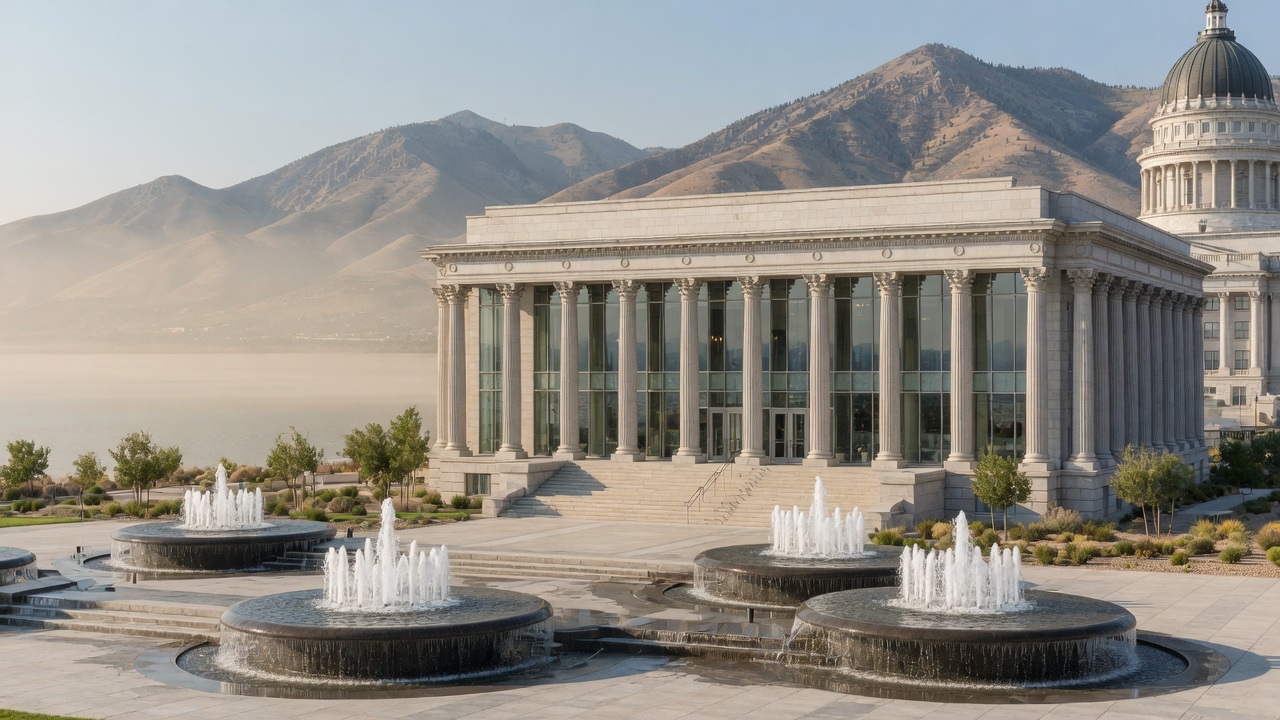
Utah State Senate · educational cover · Greek Senate · American Future Type
Salt Lake City is the capital — the Wasatch Front is not Utah
The Utah State Senate is the upper house of the Utah State Legislature. Twenty-nine Senators. Article VI of the Utah Constitution writes that chamber: a Senate and a House of Representatives, designated the Legislature of the State of Utah. Senators’ terms are four years from the first day of January next after their election. The Legislature’s own door at le.utah.gov is the roster of record.
Salt Lake City is the capital, in Salt Lake County, in the Salt Lake Valley, at the State Capitol on the hill north of downtown. The Wasatch Front — Salt Lake, Ogden, Provo, the I-15 strip — is the largest population. It is not the whole state. St. George is Washington County, Dixie, red rock and a different climate. It is not the capital. The Uinta Basin, the Colorado Plateau, the West Desert, and Cache Valley hire this chamber — twenty-nine districts, not one mountain front.
This is not a United States Senate seat. The federal files live at Utah Class I and Utah Class III. Utah has no Class II. There is no 2026 U.S. Senate race. Class I is 2030. Class III is 2028. This chamber does not vote in Congress, does not confirm federal judges, and does not sit in Washington.
This is not the Utah House of Representatives. Seventy-five desks is a different house, on a two-year clock, and all seventy-five stand in 2026. This is not the Governor — Utah’s Governor last stood in 2024 and next stands in 2028. This is not the Attorney General — that desk is also 2028. This is not the Mayor of Salt Lake City.
Utah is twenty-nine counties. A State Senate district is not the whole state. Seat packets, when they ship, teach this district. This page teaches the chamber.
This page is Side One: inform, educate, inspire. It is not the race, not legal advice, and not an official government notice. For this cycle, use the election twin.
Confirm the Senator of record on senate.utah.gov.
Fifteen mixed numbers, the first day of January
The term is four years. This chamber is staggered. Article VI says as nearly one-half as may be practicable shall be elected each biennium, as the Legislature determines by law with each apportionment. Utah Code 36-1-102 names the classes after the 2020 shapefile.
Fifteen of twenty-nine stand Tuesday, 3 November 2026. The statute class that sat in 2022 and sits again in 2026 is Districts 1, 5, 6, 7, 9, 11, 12, 13, 14, 18, 19, 20, 21, 23, and 28. That is not even-or-odd. Confirm on elections.utah.gov. Do not transplant Tennessee’s odd-number midterm rule or Texas’s lot-draw onto Utah.
Senators take office the first day of January next after their election. After this class that is Friday, 1 January 2027. The annual general session is forty-five calendar days, convening on the fourth Monday in January (Article VI and statute). After this hire that is Monday, 25 January 2027. Midnight of the forty-fifth day is the hard stop. The 2026 general session already sat. That session is not this hire.
The primary for this class already ran 23 June 2026. Filing closed 8 January 2026. Utah still runs caucuses and conventions before a primary. Confirm the current party and statute clocks on elections.utah.gov. Names that belong on a sample ballot live there — not on this page.
This chamber elects a President — the Lieutenant Governor runs elections, not this gavel
The Senate elects its own President. The Lieutenant Governor is a statewide officer, elected on a ticket with the Governor, and is Utah’s chief election officer. That desk publishes elections.utah.gov. It does not preside over this floor. Senate Rule SR1-3 is how the President is chosen. That is Utah’s clock. Texas’s statewide gavel is a different machine. Do not invent a Lieutenant Governor for this chair.
Standing committees — Revenue and Taxation; Judiciary; Education; Natural Resources, Agriculture, and Environment; Health and Human Services; Transportation and Public Utilities — are how the work is actually cut. Confirm the current book on le.utah.gov. Do not treat a news comment as the committee list.
A Senator has two homes. Capitol Hill for the session. The district for the people who hired the seat. Staff who only know State Street, or only know a Park City slope as the state, or only know St. George as Utah, are not doing the job. The Mayor of Salt Lake City is a different office (Mayor of Salt Lake City).
Forty-five calendar days and a party-liaison hole
Utah writes state law in two houses. A bill that is not passed by this Senate is not Utah law. The Governor signs or vetoes; the Legislature can override where the constitution actually gives it.
Advice and consent is state. Article VII, Section 10 is how the Governor nominates state and district officers with the consent of the Senate. Not a U.S. Senate hearing.
Vacancies in this chamber sit in Utah Code 20A-1-503. The Governor fills a Senate hole until the next regular general election by appointing the person submitted by the party liaison of the same political party as the prior senator. The unexpired term is then filled at that general, unless the vacancy falls on or after the last business day in August of an even year in which the term does not expire — then the appointment runs the remainder. That is not a special election as the default. Confirm the current text of 20A-1-503 on le.utah.gov. Do not transplant Texas’s writ onto Utah.
Utah has no legislative term limits as of this writing. A proposed constitutional amendment (HJR3 in the 2026 session) is a proposal, not a clock, until the voters actually adopt it. Confirm on elections.utah.gov. Do not teach a cap that is not law.
Qualifications sit in Article VI: a citizen of the United States, at least twenty-five, a qualified voter in the district, a resident of the state three years and of the district six months. Always verify the current text.
Redistricting is legislative. An independent commission may advise; the Legislature still enacts the shapefile. Utah Code 36-1-101.5 adopts the Senate shapefile as the boundary. Treat a statute shapefile and a court order as clocks. Confirm which map a given election actually used on the Lieutenant Governor — not on a thread.
le.utah.gov is the code and the roster
The official legislative door is le.utah.gov and senate.utah.gov. Bills, fiscal notes, committee notices, and the member of record belong there — not on a forwarded screenshot. A 45-day session is a short clock. A missed day is a real cost.
The official election door is the Utah Lieutenant Governor — Elections. Registration, county clerks, and the official sample ballot belong there and with the twenty-nine county clerks. Vote.utah.gov is the lookup the Lieutenant Governor actually publishes. Confirm the current URL on elections.utah.gov.
Staff who only know a Facebook page are not doing the job. A constituent who was told “you can vote by text” was not told the truth until a .gov page says otherwise.
Capitol Hill consent is not a St. George file
A confirmation hearing is this chamber’s justice minute: an appointee the Governor named, a board that will actually touch a license, a water right, a school, or a mine. It is not a trial. The Attorney General is the state’s lawyer (Attorney General of Utah). The Senate is not that office.
Equal protection on this map is not a Salt Lake-only file. A San Juan County precinct and a Salt Lake neighborhood hire the same Constitution. A district that never makes a Wasatch broadcast still sits in this chamber. The U.S. Attorney and a district judge are not this Senator.
Federally recognized nations sit on this map — including the Navajo Nation, the Ute Indian Tribe of the Uintah and Ouray Reservation, the Paiute Indian Tribe of Utah, the Northwestern Band of the Shoshone Nation, the Confederated Tribes of the Goshute, and the Skull Valley Band of Goshute. They are not counties. This chamber writes state law that still has to live next to that fact. Do not invent a federal Indian-affairs desk.
After a Great Salt Lake year and a canyon flood
Care this office actually gives is a bill and an oversight hour, not a church. Do not invent a ministry. A Great Salt Lake year, a canyon flood on the Colorado Plateau, a drought on West Desert ground, a fire on the Wasatch that is not a Capitol Hill press conference — those land as appropriations, emergency statutes, and questions to agencies the Governor runs.
Rural hospitals, a state prison, Medicaid as state policy, UDOT, a National Guard year in state status: the Senate does not command the Guard (the Governor does). It writes and oversees the statutes those desks live under. Chaplaincy that exists in a prison or a Guard unit is that department’s staffing. It is not this page’s pulpit.
How an apprentice learns Capitol Hill
The Legislature’s own shops — the Office of Legislative Research and General Counsel, the Legislative Fiscal Analyst, the Legislative Auditor General — are how the work is actually learned. Page and intern openings belong on official legislative and university civic pages, not on a campaign site. The University of Utah is in Salt Lake City. Utah State University is in Logan. Brigham Young University is in Provo. None of them is this chamber.
County clerks and the Lieutenant Governor’s Elections Office are how election work is learned. Salt Lake County is not this chamber. A law-school clinic that files in Salt Lake still files in a court, not in a Senate committee.
Basin, plateau, and Dixie — not one Front as the state
Census and legislative maps. The state budget versus a supplemental. A 45-day session versus a special. A lake-level report from the Great Salt Lake. A flood warning in a canyon county. A drought report from a Uinta Basin extension office. Committee attendance. Confirmation questionnaires. Dockets that a bill would actually change.
That is situational awareness for this chamber. It is not spy fiction. It is not a Mayor’s night radio. It is not the Attorney General’s case map.
Twenty-nine counties hire Salt Lake City
The inbox is a state inbox split twenty-nine ways: a capital file from Salt Lake that is not the whole Front; an Ogden / Davis / Weber file; a Utah County / Provo file; a Cache / Box Elder north file; a Summit / Wasatch mountain-resort file that is still not the capital; a Uinta Basin file from Vernal and Roosevelt; a Carbon / Emery / Price file; a San Juan / canyon country file; a West Desert / Tooele / Juab file; and a Dixie / St. George / Iron file that never makes a Wasatch broadcast.
The Great Salt Lake, the Jordan, the Bear, the Colorado, the Green, and the Virgin are this hydrology. A desert fountain is not a coastal harbor. A Wasatch postcard is not the whole state. Salt Lake City sits in the valley. The plateau is still this chamber.
Idaho is a different state. Wyoming is a different state. Colorado is a different state. Arizona is a different state. Nevada is a different state. Wendover looks at Nevada and remains Utah. St. George looks at Arizona and remains Utah.
Staff who only know the Capitol, or only know the Wasatch Front as Utah, are on the wrong office.
Place snapshot (verify official sources)
- State: Utah · Office: State Senate · 29 seats
- Term: four years from 1 January · staggered · mixed-number half this biennium (not even/odd)
- Next regular class: 3 November 2026 (Districts 1, 5, 6, 7, 9, 11, 12, 13, 14, 18, 19, 20, 21, 23, 28)
- Take office: 1 January 2027
- General session: 45 calendar days from the fourth Monday in January — 25 January 2027
- Term limits: none as law (a proposed amendment is not a clock until adopted)
- President of the Senate: elected by the body — Lieutenant Governor is the elections officer, not this gavel
- Capital: Salt Lake City (State Capitol, Salt Lake County) — Wasatch Front is not the whole state; not St. George
- Counties: 29
- U.S. Senate 2026: none (no Class II)
- Land the chamber serves: the whole state, in twenty-nine districts — Front, Basin, plateau, West Desert, Dixie
- Always verify the Senator of record on senate.utah.gov
Orientation adapted from the Utah Constitution, the Utah Legislature, and Utah official election sources for education. The Senator of record is whatever the official site says today.
What this is not
- Not a United States Senator. Utah has no Class II. Class I is 2030; Class III is 2028. No 2026 U.S. Senate race.
- Not a U.S. Representative (four House districts; two-year terms).
- Not the Utah House of Representatives (75 seats — a different chamber; all 75 on 2026).
- Not the Governor of Utah (2028, a different desk).
- Not the Lieutenant Governor of Utah (elections officer; not this gavel; next with the Governor in 2028).
- Not the Attorney General of Utah (2028, a different desk).
- Not the Mayor of Salt Lake City, Provo, Ogden, or St. George.
- Not Idaho. Not Wyoming. Not Colorado. Not Arizona. Not Nevada.
- Not the Wasatch Front as the whole state. Not St. George as the capital.
- Not a campaign flyer. This page does not tell anyone who to vote for.
Official doors
- Utah State Legislature
- Utah Senate
- Utah Lieutenant Governor — Elections
- Office of the Governor (not this chamber)
The arena: 2026 election — Utah State Senate