State Senate — Nebraska
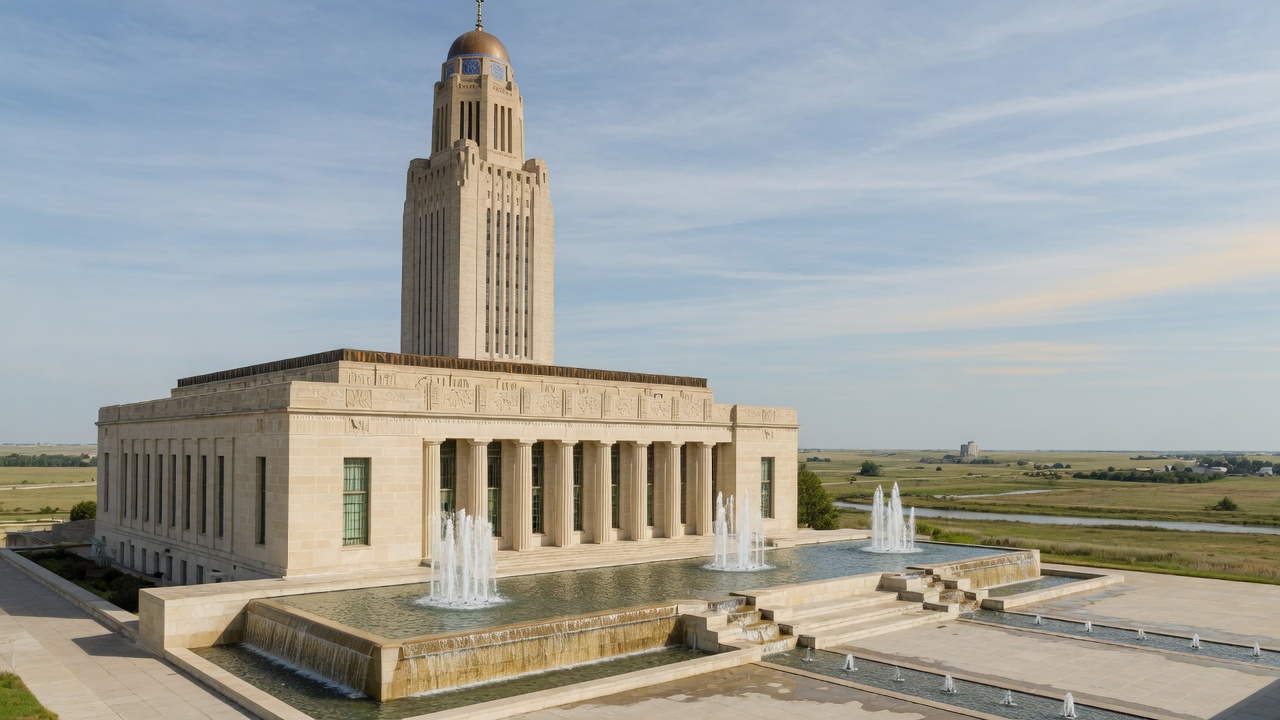
Nebraska Unicameral · educational cover · Greek Senate · American Future Type
Forty-nine Senators, one house, no second chamber
The Nebraska Legislature is the only unicameral state legislature in the United States. Members are called Senators. There are forty-nine of them. There is no Nebraska House of Representatives. There is no Nebraska Assembly. There is no second house to pass a bill to. The people, through initiative and referendum, are the check that other states put in a second chamber. Teach that clock. Do not invent a lower house.
Article III of the Nebraska Constitution writes this body: not more than fifty members and not less than thirty. Current law fills forty-nine single-member districts. The Legislature’s own door at nebraskalegislature.gov is the roster of record.
The term is four years. Nebraska staggers this chamber. Even-numbered districts stand in 2022, 2026, 2030. Odd-numbered districts stand in 2024, 2028. That is the Secretary of State’s own elected-offices clock (sos.nebraska.gov). 2026 is the even-numbered class — districts 2, 4, 6 … 48, twenty-four seats — plus Legislative District 41, which the same official list puts on the 2026 primary and general for a two-year remainder. Confirm the current remainder on the Secretary of State. Do not invent a 2026 race for an odd-numbered district that is not 41.
Senators assume office the first Wednesday after the first Monday in January. After 2026 that is Wednesday, 6 January 2027. Regular session begins 10 a.m. that day (Article III-10). Odd-numbered years: not more than ninety legislative days. Even-numbered years: not more than sixty, unless four-fifths extend it. That is Nebraska’s clock. It is not midnight of election day. It is not Nevada’s next-day oath. It is not a fake second house.
This is not a United States Senate seat. The federal files live at Nebraska Class II and Nebraska Class I. Class II is on 3 November 2026. This chamber does not vote in Congress, does not confirm federal judges, and does not sit in Washington.
This is not a State House. There is none. This is not the Governor — Nebraska’s Governor is also on 2026, a different desk. This is not the Attorney General. This is not the Mayor of Lincoln.
Lincoln is the capital, in Lancaster County, on the prairie and Salt Creek, under the Art Deco Capitol tower — a tower, not a round dome. Omaha is the largest city. It is not the capital. The Sandhills, Panhandle, Platte valley, and a river town that never makes an Omaha broadcast hire this chamber — forty-nine districts, one house.
Nebraska is ninety-three counties. A legislative district is not the whole state. Seat packets, when they ship, teach this district. This page teaches the chamber.
This page is Side One: inform, educate, inspire. It is not the race, not legal advice, and not an official government notice. For this cycle, use the election twin.
Confirm the Senator of record on nebraskalegislature.gov.
The Lieutenant Governor presides the Unicameral
The Lieutenant Governor is President of the Legislature (Article III-10). The Lieutenant Governor votes only when the body is equally divided, and does not break a tie on final passage of a bill. The body elects a Speaker by secret ballot to preside when the Lieutenant Governor is absent, incapacitated, or acting as Governor. Officers and committee chairs are chosen by secret ballot, not by a party caucus as other states run it. This Legislature is officially nonpartisan. The ballot does not print a party. Do not transplant a majority-leader machine from a bicameral state onto Lincoln.
A Senator has two homes. The Capitol for the session. The district for the people who hired the seat. Staff who only know downtown Omaha as the state, or only know a campus town as Nebraska, are not doing the job. The Capitol is the capitol. The Mayor of Lincoln is a different office (Mayor of Lincoln).
Even-numbered districts, plus a District 41 remainder
Nebraska writes state law in one house. A bill that is not passed by this Legislature is not Nebraska law. There is no conference committee with a second chamber. The Governor signs or vetoes; the Legislature can override where the constitution actually gives it.
Advice and consent is state. Boards and appointments the constitution and statute actually name. Not a U.S. Senate hearing. Not a confirmation that has to clear a House that does not exist.
Vacancies in this chamber are filled by Governor appointment until the next general election. Confirm on the Secretary of State and the Legislature. Do not invent a special as the default. Do not invent a second-house caucus.
Legislative term limits are a clock. Current law: two consecutive four-year terms. A 2026 statewide ballot measure (LR 19CA) asks voters whether to move that cap to three consecutive four-year terms. Confirm the current text and the sample ballot on the Secretary of State — do not treat a campaign mailer as the constitution, and do not invent the result of a measure that has not been counted.
Qualifications: a citizen of the United States, at least twenty-one, a registered voter, and a resident of the district for one year. This page is teaching, not a filing packet.
Redistricting is legislature-dominant. Treat a statute and a court order as clocks. Confirm which map a given election actually used on the Secretary of State — not on a thread.
Elections for this desk are nonpartisan. Primary and general both run without a party label on the legislative line. That is Nebraska’s clock. It is not Missouri. It is not Nevada.
nebraskalegislature.gov is the ledger
The official legislative door is nebraskalegislature.gov. Bills, fiscal notes, committee notices, the Unicameral Update, and the member of record belong there — not on a forwarded screenshot. Session calendars and today’s schedule are posted on that site. A sixty-day even year and a ninety-day odd year are still real calendars. A missed committee is still a real cost.
The official election door is the Nebraska Secretary of State and vote.sos.ne.gov. Registration, ballot status, and the sample ballot belong there and with the ninety-three county election commissioners and county clerks.
Staff who only know a Facebook page are not doing the job. A constituent who was told “you can vote by text” was not told the truth until a .gov page says otherwise.
Lincoln consent, not an Omaha file
A confirmation hearing is this chamber’s justice minute: an appointee the Governor named, a board that will actually touch a license, a prison, a school, or a river compact. It is not a trial. The Attorney General is the state’s lawyer (Attorney General of Nebraska). The Unicameral is not that office.
Equal protection on this map is not an Omaha-only file. A Sheridan County precinct and a Douglas County neighborhood hire the same Constitution. A district that never makes a river-city broadcast still sits in this chamber. The U.S. Attorney and a district judge are not this Senator.
There is no second house to “check” a rural district. The check is the constitution, the Governor’s veto, the courts, and the people on the ballot — including initiative and referendum. Do not invent a House committee.
After a blizzard year and a Platte rise
Care this office actually gives is a bill and an oversight hour, not a church. Do not invent a ministry. A blizzard on the Panhandle, a rise on the Platte, a drought on Sandhills ground that never makes a Lincoln press conference, an ice night on a river town that is not Omaha — those land as appropriations, emergency statutes, and questions to agencies the Governor runs.
Rural hospitals, a state prison, Medicaid as state policy, NDOT, a National Guard year in state status: the Legislature does not command the Guard (the Governor does). It writes and oversees the statutes those desks live under. Chaplaincy that exists in a prison or a Guard unit is that department’s staffing. It is not this page’s pulpit.
How a student learns Norris's experiment
George W. Norris’s 1934 amendment and the first Unicameral in January 1937 are this state’s civic school, not a costume. The Clerk of the Legislature, bill drafting, the Legislative Fiscal Office, and the Unicameral Information Office are how the work is actually learned. Page and intern openings belong on official legislative and university civic pages, not on a campaign site. A student who wants the civic path confirms those doors on .gov and campus postings. The University of Nebraska–Lincoln is a university. It is not the capital building.
County clerks and the Secretary of State are how election work is learned. Lancaster County is not this chamber. A law-school clinic that files in Lincoln still files in a court, not in a legislative committee.
Sandhills and river towns, not one skyline
Census and a legislative map. The state budget versus a supplemental. A ninety-day / sixty-day clock. A blizzard warning on the Panhandle. A river report from the Platte. A drought report from a Sandhills extension office. Committee attendance. Confirmation questionnaires. Dockets that a bill would actually change.
That is situational awareness for this chamber. It is not spy fiction. It is not a Mayor’s night radio. It is not the Attorney General’s case map. It is not a second house.
Ninety-three counties hire Lincoln
The inbox is a state inbox split forty-nine ways: a capital file from the prairie tower that is not Omaha; a Douglas / Sarpy metro file that is the largest population and still not the capital; a Lincoln Lancaster file; a Platte farm-and-river file; a Sandhills cattle file; a Panhandle high-plains file; a Missouri River east file; and a Kearney / Grand Island / North Platte middle file that is still only slices of this chamber.
The Platte, the Missouri, the Niobrara, the Republican, and Salt Creek at the capital are this hydrology. A desert fountain is not this land. An Omaha postcard is not the whole state. Lincoln is inland prairie. The Sandhills are still this chamber.
Iowa is a different state. Missouri is a different state. Kansas is a different state. Colorado is a different state. Wyoming is a different state. South Dakota is a different state. Council Bluffs looks at Omaha and remains Iowa. South Sioux City remains Nebraska.
Staff who only know the Capitol, or only know Omaha as Nebraska, are on the wrong office.
Place snapshot (verify official sources)
- State: Nebraska · Office: Unicameral Legislature (Senators) · 49 seats · one chamber
- Term: four years · staggered · even-numbered districts on 2026, plus District 41 two-year remainder
- Next regular class: 3 November 2026 (even numbers + 41); odd numbers 2028
- Take office: first Wednesday after the first Monday in January (6 January 2027, 10 a.m. session)
- Term limits: two consecutive four-year terms (confirm any 2026 ballot change on the SOS)
- Ballot: nonpartisan
- Capital: Lincoln (State Capitol tower, Lancaster County, prairie / Salt Creek) — not Omaha
- Counties: 93
- Land the chamber serves: the whole state, in forty-nine districts — prairie, Sandhills, Panhandle, Platte, Missouri River towns
- Always verify the Senator of record on nebraskalegislature.gov
Orientation adapted from the Nebraska Constitution, the Legislature, and Nebraska official election sources for education. The Senator of record is whatever the official site says today.
What this is not
- Not a United States Senator (Class II is 2026; Class I is 2030).
- Not a U.S. Representative (three House districts; two-year terms).
- Not a Nebraska House of Representatives. There is none.
- Not the Governor of Nebraska (2026, a different desk). Not the Lieutenant Governor (President of this Legislature, a different office).
- Not the Attorney General of Nebraska (2026).
- Not the Mayor of Lincoln or Omaha.
- Not Iowa. Not Missouri. Not Kansas. Not Colorado. Not Wyoming. Not South Dakota.
- Not Omaha as the capital. Not a second chamber. Not a partisan legislative ballot.
- Not a campaign flyer. This page does not tell anyone who to vote for.
Official doors
- Nebraska Legislature
- Senator roster
- Nebraska Secretary of State
- Nebraska voter lookup
- Office of the Governor (not this chamber)
The arena: 2026 election — Nebraska Unicameral