State Senate — Alaska
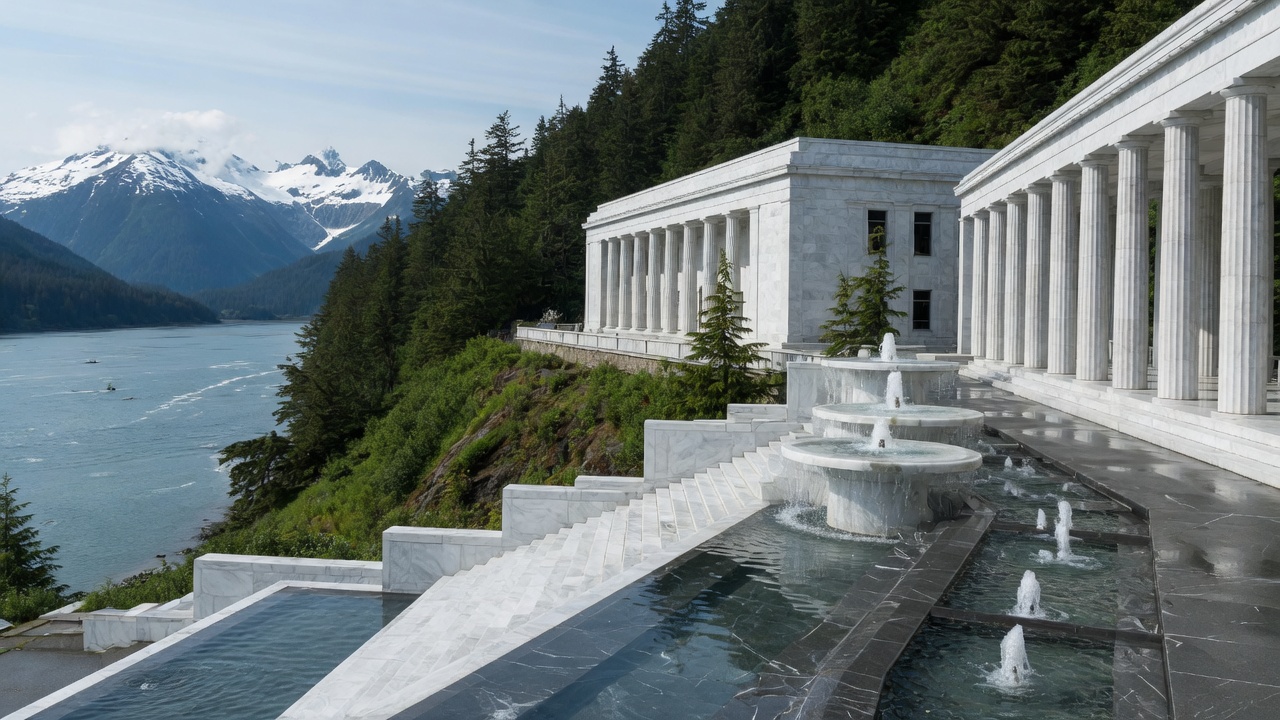
Alaska State Senate · educational cover · Greek Senate · American Future Type
Twenty desks on Gastineau Channel
The Alaska State Senate is the upper house of the Alaska Legislature. Twenty Senators. That number is in Article II, Section 1 of the Alaska Constitution: a senate of twenty, a house of forty. Each Senate district is two House districts laid together when the Redistricting Board can do it. The Legislature’s own door at akleg.gov is plain: twenty desks, not one skyline.
This is not a United States Senate seat. The federal files live at Alaska Class II and Alaska Class III. Class II is on 3 November 2026. That is a different desk. This chamber does not vote in Congress, does not confirm federal judges, and does not sit in Washington.
This is not the Alaska House of Representatives. Forty desks, two-year terms, all up every even year — a different house. This is not the Governor. This is not a Mayor. This is not an elected sheriff. Alaska has none.
Juneau is the capital, on Gastineau Channel in the Southeast panhandle. It is not on the road system to Anchorage. Anchorage is the largest city. It is not the map. The Railbelt, the Bush, the North Slope, the Aleutians, the Interior, and a panhandle town that never makes a Ted Stevens broadcast hire this chamber — twenty districts, not one airport.
Alaska does not use counties. The map is organized boroughs and the Unorganized Borough (census areas). Do not invent sheriffs. Do not paste a Lower-48 county file onto this desk.
This page is Side One: inform, educate, inspire. It is not the race, not legal advice, and not an official government notice. For this cycle, use the election twin.
Confirm the Senator of record on akleg.gov — Senate.
Article II and the half-chamber clock
The term is four years. Alaska staggers this chamber. Article II, Section 3: one-half of the senators shall be elected every two years. There are no legislative term limits.
2026 is the odd-letter class: districts A, C, E, G, I, K, M, O, Q, S — ten of twenty. The even letters (B, D, F, H, J, L, N, P, R, T) sat in 2024 and sit again in 2028. Do not invent a 2026 race for a letter that is not up. Do not treat Alabama’s all-up quadrennium as this clock.
The next regular election for this class is Tuesday, November 3, 2026. Winners take office in January after the election — after a gubernatorial year, the third Tuesday in January (the constitution’s default is the fourth Monday of January “unless otherwise provided by law”; AS 24.05.080 and the Legislature’s own convening clock are what to confirm). That is not midnight of election day. That is not California’s first Monday in December.
A Senator shall be at least twenty-five, a qualified voter, a resident of Alaska for three years, and of the district for one year immediately preceding filing (Article II, Section 2). Always verify the current text. This page is teaching, not a filing packet.
The body elects its own President. The Lieutenant Governor of Alaska does not preside here. That is a different constitution than Arkansas or California.
Vacancies are filled as provided by law; if no provision is made, the Governor appoints (Article II, Section 4). Do not invent a holdover. Confirm on the Division of Elections and akleg.gov.
BASIS is the door, not a rumor
The official legislative door is akleg.gov. Bills, amendments, committee notices, and the member of record belong on BASIS — not on a forwarded screenshot. Session calendars and today’s schedule are posted there.
The official election door is the Division of Elections. Registration, ballot status, and the sample ballot belong on that site and on the regional elections offices — not sixty-seven county boards, because Alaska does not have that map.
Staff who only know a Facebook page are not doing the job. A constituent who was told “you can vote by text” was not told the truth until a .gov page says otherwise.
Alaska’s top-four primary and ranked-choice general are state election law. Teach the clock on the Division of Elections. Do not import another state’s runoff.
Regular session is a 120-day clock (with a short extension the constitution actually allows). A missed week in Juneau is a real cost. The capital is a plane or a ferry from most of the people who hired the seat. Two homes: Juneau for the session. The district for the hire.
Confirmations that never leave the state
A confirmation hearing is this chamber’s justice minute: an appointee the Governor named, a board that will actually touch a license, a fishery, a village clinic, or a pipeline. It is not a trial. It is not a U.S. Senate hearing. The Attorney General of Alaska is appointed. Do not invent a 2026 AG race. The Senate is not that office.
Equal protection on this map is not an Anchorage-only file. A census area that never makes a live shot still sits in this chamber. A village that votes by plane still hires a Senator. The U.S. Attorney and a superior-court judge are not this desk.
Redistricting is the Redistricting Board, not a legislative self-draw. Maps get litigated. Treat a court order and a stay as clocks, not as slogans. Confirm which map a given election actually used on the Board and the Division of Elections.
After a clinic year and a fire season
Care this office actually gives is a bill and an oversight hour, not a church. Do not invent a ministry. A village clinic that travels by plane, a fire year in the Interior, a Bristol Bay fishery opening, a Slope winter that is not a Juneau press conference — those land as appropriations, emergency statutes, and questions to agencies the Governor runs.
The Permanent Fund is state law, not a slogan. The Alaska Marine Highway, a National Guard year in state status, Medicaid as state policy: the Senate does not command the Guard (the Governor does). It writes and oversees the statutes those desks live under. Chaplaincy that exists in a Guard unit or a correctional facility is that department’s staffing. It is not this page’s pulpit.
How a student learns this boule
The Legislature’s own shops — bill drafting, fiscal notes, the Legislative Affairs Agency, BASIS — are how the work is actually learned. Page, intern, and session-staff openings belong on official legislative and university civic pages, not on a campaign site. A student who wants the civic path confirms those doors on .gov and campus postings.
Election work is learned at the Division of Elections and the regional offices. There is no county Board of Registrars to copy from the Lower 48. A law-school clinic that files in Anchorage still files in a court, not in a Senate committee. Juneau is the session. The district is the hire.
Ice, fish, and a 120-day clock
Census and reapportionment. Oil revenue and the Fund as the constitution and statute actually write them. A 120-day session in a capital that is not on the road. A fire-weather year. An ice-road year. A salmon opening. A ferry-drydock year. Committee attendance. Confirmation questionnaires. Dockets that a bill would actually change.
That is situational awareness for this chamber. It is not spy fiction. It is not a Mayor’s night radio. It is not a sheriff’s county — Alaska does not elect that office.
Boroughs and the Bush hire this chamber
The inbox is a state inbox split twenty ways: a capital file from Juneau that arrives by air or ferry; an Anchorage metro file that is not the capital; a Fairbanks Interior file; a North Slope energy-and-village file; a Bush clinic that travels by plane; a Bristol Bay or Kodiak fisheries file; an Aleutian file; a Kenai and Mat-Su Railbelt file; and a panhandle town — Sitka, Ketchikan, Wrangell — that looks south and remains Alaska.
The Yukon is not a license to treat a Border village as Canada. Utqiaġvik is Alaska, not a postcard. Ketchikan is Alaska, not a British Columbia afterthought. A desert fountain is not this land. A Gulf-of-Mexico postcard is not this channel.
Staff who only know the airport in Anchorage, or only know South Franklin in Juneau as the whole state, are on the wrong office.
Place snapshot (verify official sources)
- State: Alaska · Office: State Senate · 20 seats
- Term: four years · staggered · half the chamber every even year
- 2026 class: odd letters A, C, E, G, I, K, M, O, Q, S (ten seats)
- Next regular election for this class: 3 November 2026
- Take office: January after the election (gubernatorial year: third Tuesday — confirm AS 24.05.080)
- Capital: Juneau (Gastineau Channel, Southeast panhandle) — not Anchorage
- Map: boroughs and census areas · no counties · no elected sheriffs
- House: 40 desks, two-year terms — a different chamber
- Always verify the Senator of record on akleg.gov
Orientation adapted from the Alaska Constitution, akleg.gov, and the Division of Elections for education. The Senator of record is whatever the official site says today.
What this is not
- Not a United States Senator (Class II is 2026; Class III is 2028).
- Not a U.S. Representative (one at-large House seat; two-year term).
- Not the Alaska House of Representatives (40 seats — a different chamber).
- Not the Governor of Alaska. Not the Lieutenant Governor (this Senate elects its own President).
- Not an elected Attorney General (Alaska appoints).
- Not the Mayor of Juneau or Anchorage.
- Not a county sheriff. Alaska does not elect that office.
- Not Anchorage as the capital. Not the Railbelt as the whole state.
- Not a campaign flyer. This page does not tell anyone who to vote for.
Official doors
- Alaska Legislature
- Alaska Legislature — BASIS
- Division of Elections
- Office of the Governor (vacancy appointment is a different desk — not this chamber)
The arena: 2026 election — Alaska State Senate